Sunday, 28 June 2020

Scimago Journal & Country Rank - IJEPR in Quartile 2 in Urban Studies


The IJEPR is in Quartile 2 in the category 'Urban Studies' in Scimago Journal & Country Rank 2019, moving up from Quartile 3 in 2018.

In the 2019 Scimago Journal & Country Rank the International Journal of E-Planning Research (IJEPR) is in Quartile 2 (Q2) in the category 'Urban Studies' moving from Quartile 3 (Q3) in 2018. In the categories 'Geography, Planning and Development' and in 'Computer Science Applications' it is in Quartile 3 (Q3) as in 2018.

According to the Scimago ranking system, Q1 comprises the quarter of the journals with the highest values, Q2 the second highest values, Q3 the third highest values and Q4 the lowest values.

 More information on IJEPR in Scimago Journal & Country Rank: https://www.scimagojr.com/journalsearch.php?q=21100855506&tip=sid&clean=0


Scopus CiteScore 2019

 
INTERNATIONAL JOURNAL OF E-PLANNING RESEARCH
 
 
URBAN STUDIES (69th Percentile)
 

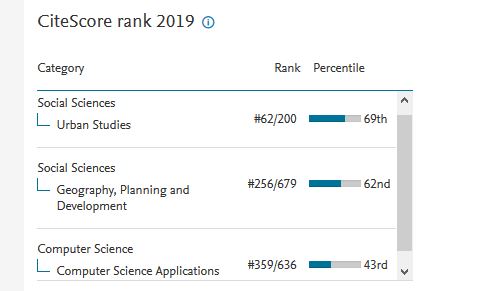
The International Journal of E-Planning Research (IJEPR) has a CiteScore 2019 = 1,9. The CiteScore for 2020 is currently 2,2.  

The IJEPR is in Percentlie 69th in the category 'Urban Studies' and 62th in the category 'Geography, Planning and Development'.   

More information on IJEPR in Scopus CiteScore: https://www.scopus.com/sourceid/21100855506
 

Saturday, 27 June 2020

IJEPR in SCOPUS CiteScore 2019


The International Journal of E-Planning Research (IJEPR) is well ranked in the just released SCOPUS CiteScore 2019 with a score of 1,9. The CiteScore for 2020 is currently 2,2.
The IJEPR is in Percentlie 69th in 'Urban Studies' and 62th in 'Geography, Planning and Development'. 


Friday, 26 June 2020

IJEPR in the Emerging Sources Citation Index (ESCI) _ 2019


The Emerging Sources Citation Index (ESCI) was launched in 2015 by Thomson Reuters as a new database in Web of Science. Since 2017 the index has been produced by Clarivate Analytics. It started with around 3,000 journals, covering the full range of subject areas. 

The Emerging Sources Citation Index aims to extend the scope of publications in the Web of Science to include high-quality, peer reviewed publications. It ensures important research is visible in the Web of Science Core Collection. 

The selection process for ESCI is the first step before the journal can be considered for inclusion in other Web of Science indexes. These include the Science Citation Index (SCI), Social Science Citation Index (SSCI), and Arts and Humanities Citation Index (AHCI). 

Journals accepted for coverage must meet several criteria (to be peer reviewed; to follow ethical publishing practices; to meet certain technical requirements, etc.) 

All journals submitted to the core Web of Science databases will be evaluated. If they’re successful they will be indexed in the ESCI while undergoing more in-depth editorial review. Journals can also move from the core Web of Science Indexes to the ESCI if they no longer meet the conditions of that index.
 
Journals indexed in the ESCI will not receive Impact Factors. However, citations from the ESCI will be included in the citation counts for Journal Citation Reports. Citations from the ESCI will contribute to the Impact Factors of other journals. 

Articles in ESCI indexed journals will be included in an author’s h-index calculation.  

Inclusion in the ESCI improves the visibility of the journal and represents a mark of quality. 
 

Thursday, 18 June 2020

International Journal of E-Planning Research (IJEPR), Volume 9, Issue 3, July - September 2020


International Journal of E-Planning Research (IJEPR)

Volume 9, Issue 3,  July - September 2020

Published: Quarterly in Print and Electronically
ISSN: 2160-9918; EISSN: 2160-9926

Published by IGI Global Publishing, Hershey, USA
www.igi-global.com/ijepr  

Indexed by: Compendex (Elsevier Engineering Index), INSPEC, SCOPUS, Web of Science Emerging Sources Citation Index (ESCI)  

Editor-in-Chief: Carlos Nunes Silva (University of Lisbon, Portugal)  
 

EDITORIAL PREFACE

Co-Creation With Digital Technologies in Spatial Planning
Carlos Nunes Silva (Institute of Geography and Spatial Planning, Universidade de Lisboa, Lisbon, Portugal) 


Conceptualising the Use of Digital Technologies in Spatial Planning: A Progress Report on Innovation in Britain

Barry Goodchild (Sheffield Hallam University, UK)  

This article is about how best to frame the use of digital technology in spatial planning and how best to frame the evaluation of impact. The different sections argue the following points. First, the conceptualisation of digital technologies in spatial planning should pay less attention to the discourse of smart cities and more to pragmatic approaches that can cope with the Janus-faced character of technology and provide a bridge to planning theory. Then, as revealed by the assumptions of actor network theory, there are three main innovation paths—Prop-Tech, Civic-Tech, and Project-Tech—all of which have a different pattern of beneficiaries. Then, as revealed by structuration theory and unless moderated by professional ethics and explicit policy commitments, technology is likely to be concerned with the cost effectiveness of working practices. Finally, taking the various approaches together, spatial planning may be conceptualised as a field of heterogeneous elements (stakeholders and citizens, technology, place) with non-local governance and markets as external structuring forces. 

To obtain a copy of the entire article, click on the link below.
www.igi-global.com/article/conceptualising-the-use-of-digital-technologies-in-spatial-planning/256873 

To read a PDF sample of this article, click on the link below.
www.igi-global.com/viewtitlesample.aspx?id=256873&isxn=9781799807834
 

Pasikola: A Co-Creation Process in Urban Transportation Innovation of Makassar City, Indonesia
Zulfikar Dinar Wahidayat Putra (Gadjah Mada University, Indonesia), Wim G.M. van der Knaap (Wageningen University, The Netherlands)   

In this digital era, innovation becomes an important element within urban planning and management to support a more effective and efficient urban service. Until now, most of the local governments in Indonesia still rely on a fully top-down approach to solve urban transportation problems. This article investigates the co-creation process in solving an urban transportation problem in Makassar City, Indonesia, by analyzing key success factors of the process. A literature review and semi-structured interviews were used to gather data from key actors involved in the process. It revealed that there are five important factors contributing to the success of a co-creation process, namely back up from the mayor, diversity of stakeholder involvement, local NGO facilitation, international NGO facilitation, and a committed team. A combination of the top-down approach and co-creation, as a participatory approach, and utilization of digital means seems to offer an opportunity for a more effective and impactful urban solution implementation in a contemporary (Indonesian) city.   

To obtain a copy of the entire article, click on the link below.
www.igi-global.com/article/pasikola/256874   

To read a PDF sample of this article, click on the link below.
www.igi-global.com/viewtitlesample.aspx?id=256874&isxn=9781799807834
 

Digital Participatory Platforms for Urban Regeneration: A Survey of Italian Case Studies
Francesca De Filippi (Politecnico di Torino, Italy), Cristina Coscia (Politecnico di Torino, Italy), Grazia Giulia Cocina (Politecnico di Torino, Italy)   

Despite the increase in the globally connected population, there is still a high percentage of European citizens who do not have basic digital skills. In the era of smart cities, the Digital Divide affects the possibility for citizens to participate in public life through the use of ICT tools. To deal with this issue, the European Union promotes strategies to develop e-government tools, such as digital participatory platforms (DPPs), in order to connect citizens with the public administration. The research proposes a survey of Italian DPPs, investigated through a questionnaire, to bring out which strategies have been adopted in relation to participation, social inclusion and digital illiteracy, transparency of data, processes, and user-friendliness of the platform. With regard to these issues, certain elements of success of the DPPs presented are highlighted.  

To obtain a copy of the entire article, click on the link below.
www.igi-global.com/article/digital-participatory-platforms-for-urban-regeneration/256875   

To read a PDF sample of this article, click on the link below.
www.igi-global.com/viewtitlesample.aspx?id=256875&isxn=9781799807834


How to Humanize Technology in Smart Cities
Zvi Weinstein (Israel Smart Cities Institute, Israel)   

The article describes a personal point of view on the relationships between technology innovations in smart cities and how they are used for the benefits of the residents. Are they technologically or humanly characterized? Are we able to humanize technology for the need of the residents? Addressing my point of view, first of all, I have to confess that I belong to the “x” generation and therefore a gap divides me from updated technologies that are born almost every minute around the globe. Second, this is not a research paper or data analysis. Third, an additional set of questions will focus on the direction/s technology is pushing the interfaces with city residents. The paper argues that citizen-centered humanized approach for the future of smart cities is needed for shifting technology- centered to human and social considerations.   

To obtain a copy of the entire article, click on the link below.
www.igi-global.com/article/how-to-humanize-technology-in-smart-cities/256876  

To read a PDF sample of this article, click on the link below.
www.igi-global.com/viewtitlesample.aspx?id=256876&isxn=9781799807834 


BOOK REVIEW  

Space and Planning in Secondary Cities

Carlos Nunes Silva (Institute of Geography and Spatial Planning, Universidade de Lisboa, Lisbon, Portugal) 


Monday, 15 June 2020

International Journal of E-Planning Research (IJEPR) _Description, June 2020


The International Journal of E-Planning Research (IJEPR) publishes original theoretical and innovative empirical research on the many aspects of the emerging interdisciplinary area of urban e-planning. The journal is mainly focused on urban e-planning theory, history, methods, ethics, best practices, urban e-planning pedagogy, future developments, and on the software technology associated with urban e-planning. Due to its comprehensive coverage, this international journal has been accepted into prestigious indices, most notably Web of Science® – Emerging Sources Citation Index®, Scopus®, Compendex®, INSPEC®, as well as has been selected in notable journal lists, including in the Class A scientific journals by the Italian National Agency for the Evaluation of Universities and Research Institutes (2018-2020), in the Excellence in Research for Australia list from the Australian Research Council (ERA 2018 Journal List - ERA Journal Id 210655), and in the International Geographical Union (IGU) list of journals. Led by an editor who has extensively contributed his research within this field to numerous reference works, including to a plethora of IGI Global publications, this journal is associated with the Urban E-Planning Research Network and the International Conference on Urban E-Planning, which is convened by the editor-in-chief and hosted by the University of Lisbon.

Monday, 1 June 2020

Wednesday, 8 April 2020

IJEPR - Class A Journal


The 'Italian National Agency for the Evaluation of Universities and Research Institutes' (ANVUR) included the 'International Journal of E-Planning Research' (IJEPR) in the list of excellence for academic journals (Class A).
 
The class A journals are considered the best journals in the Italian academic assessment system.
 
The IJEPR is included in Category 8 (Civil Engineering and Architecture disciplines, Architectural Design and Technology; Spatial Planning).

See all lists of recognized scientific journals and Class A journals here »»

This recognition is an important acknowledgement of the quality of the 'International Journal of E-Planning Research' (IJEPR).

Wednesday, 4 March 2020

International Journal of E-Planning Research (IJEPR), Volume 9, Issue 4 , October - December 2020


International Journal of E-Planning Research (IJEPR)

Volume 9, Issue 4,  October - December 2020
Published: Quarterly in Print and Electronically
ISSN: 2160-9918; EISSN: 2160-9926;
Published by IGI Global Publishing, Hershey, USA


Editor-in-Chief: Carlos Nunes Silva (University of Lisbon, Portugal)
 
(full issue available online soon)

Tuesday, 25 February 2020

International Journal of E-Planning Research (IJEPR), Volume 9, Issue 2, April - June 2020


International Journal of E-Planning Research (IJEPR)

Volume 9, Issue 2,  April - June 2020
Published: Quarterly in Print and Electronically
ISSN: 2160-9918; EISSN: 2160-9926;
Published by IGI Global Publishing, Hershey, USA

Editor-in-Chief: Carlos Nunes Silva (University of Lisbon, Portugal)
 

Indexed by: Compendex (Elsevier Engineering Index), INSPEC, SCOPUS, Web of Science Emerging Sources Citation Index (ESCI)
For a complete list of indexing and abstracting services that include this journal, please reference the bottom of this announcement.

Note: The International Journal of E-Planning Research (IJEPR) has an Open Access option, which allows individuals and institutions unrestricted access to its published content. Unlike traditional subscription-based publishing models, open access content is available without having to purchase or subscribe to the journal in which the content is published. All IJEPR manuscripts are accepted based on a double-blind peer review editorial process.


EDITORIAL PREFACE
 

CITIZEN ENGAGEMENT IN URBAN E-PLANNING AND SUSTAINABLE DEVELOPMENT
Carlos Nunes Silva (Institute of Geography and Spatial Planning, Universidade de Lisboa, Lisbon, Portugal)


RESEARCH ARTICLES
 

ENGAGING THE CROWD: LESSONS FOR OUTREACH AND TOOL DESIGN FROM A CREATIVE ONLINE PARTICIPATORY STUDY
Johannes Mueller (ETH Zurich, Future Cities Laboratory, Singapore-ETH Centre, Singapore), Shiho Asada (ETH Zurich, Future Cities Laboratory, Singapore-ETH Centre, Singapore), Ludovica Tomarchio (ETH Zurich, Future Cities Laboratory, Singapore-ETH Centre, Singapore) 
 
In this article, the challenges of realising e-participatory projects in urban planning are described. A participatory case study in Singapore serves as the basis for their presented conclusions. The researchers used a map-based e-participation tool to collect design proposals from participants for the planning site. The user feedback for the tool interface and the study campaign's website together with designer expertise on user interfaces (UI) was incorporated into the redesign of the website and interface of the participatory design tool. From there, some general guidelines for conducting engagement studies and for designing participatory design tool interfaces for non-expert users were formulated. One key finding is that the information presented to the non-expert user must be concise, and the UI must be adapted to the user's habits and focus the user's attention towards completing the study.


COMMUNICATION-ORIENTED AND PROCESS-SENSITIVE PLANNING SUPPORT
Aija Staffans (Aalto University, Finland), Maarit Kahila-Tani (Aalto University & Mapita Ltd., Finland), Stan Geertman (Utrecht University, The Netherlands), Pihla Sillanpää (Aalto University, Finland), Liisa Horelli (Aalto University, Finland)
 
The complexity of the planning context has raised criticism against public participation for being a rigid top-down endeavour which does not recognize the different communicative needs and necessary working modes in the engagement of broad publics and collaborative small groups. Consequently, the problem is how to improve public participation so that it becomes more sensitive to the variety of communicative activities and knowledge needs involved in the design of urban planning processes. The aim of the article is to present and discuss, on the basis of two small case studies in the Finnish context, a revised model for a process-sensitive planning support system (PSS), with examples of several digital tools. The authors argue that besides broad public participation, more collaboration is needed to converge the diverse knowledge of planning in two-way communication and co-working settings which enable the analysis and design of living environments.


TOOLS FOR SUSTAINABLE CHANGE: HOW SPATIAL DECISION-SUPPORT TOOLS SUPPORT TRANSFORMATIVE URBAN REGENERATION
Rita De Jesus Dionisio (University of Canterbury, New Zealand), Mirjam Schindler (Victoria University of Wellington, New Zealand), Simon Kingham (University of Canterbury, New Zealand)
 
This research focuses on the ability of spatial decision-support tools (SDST) to transform urban regeneration processes through collaborative planning between authorities and communities. This article presents what was learned from the implementation of two SDST within planning authorities in Aotearoa, New Zealand. The first tool, Envision, enables the identification of suitable areas for urban regeneration; the second, ESP, focuses on the environmental and socio-economic assessment of regeneration scenarios at the neighbourhood scale. We use empirical observations from the implementation of these SDST in diverse planning authorities, to analyse the influence of local specificities and appropriate collaboration models for the development and adoption of the tools for decision-making and community engagement. We provide recommendations for future development and implementation of SDST to reinforce collaborative planning and local governance within urban regeneration processes.


CAN WE ENABLE DIGITAL TRANSITION IN HEALTHCARE DELIVERY?: INSIGHTS FROM A SURVEY OF TELEMEDICINE SERVICES IN THE PIEDMONT REGION
Sylvie Occelli (IRES Piemonte, Italy), Bibiana Scelfo (Ires Piemonte, Italy) 

Implementing digital health transition is challenging. Whilst technology progresses rapidly, the appropriation of innovation in healthcare is slower and has to deal with the local context. This is the case with Piedmont, an Italian region where in the last decade a number of telemedicine projects have been launched. In order to assess their implementation a survey has been recently conducted by the regional Health Department. This work builds upon the results of this investigation. The conceptual approach underlying the survey is illustrated and the main findings of the investigation discussed. To examine the regional situation, a notion of telemedicine maturity model is used. By making it explicit the main dimensions entailed in developing an ehealth service, its application can facilitate the digital health transition in the region. A core argument is that to handle the complexity of ehealth projects a collaborative environment for exchanging health knowledge should be implemented.


BOOK REVIEW 

Participatory Design Theory: Using Technology and Social Media to Foster Civic Engagement
Carlos Nunes Silva (Institute of Geography and Spatial Planning, Universidade de Lisboa, Lisbon, Portugal)
 

Tuesday, 31 December 2019

International Journal of E-Planning Research (IJEPR) - Editorial Board 2020

International Journal of E-Planning Research (IJEPR)

Editorial Board 2020

Editor-in-chief
          Carlos Nunes Silva, University of Lisbon, Portugal
International Advisory Board
Ian Bishop, University of Melbourne, Australia
Roger Caves, San Diego State University, United States
Richard Klosterman, University of Akron, United States
Karen Mossberg, Arizona State University, United States
Willem Salet, University of Amsterdam, Netherlands
Associate Editors
Ari-Veikko Anttiroiko, Tampere University, Finland
Soon Ae Chun, City University of New York, Staten Island, United States
Jon Corbett, University of British Columbia Okanagan, Canada
Lukasz Damurski, Wroclaw University of Technology, Poland
Michael McCall, National Autonomous University of Mexico, Mexico
Scott McQuire, University of Melbourne, Australia
Nancy Odendaal, University of Cape Town, South Africa
Editorial Review Board
Stephen Aikins, University of South Florida, United States
Kheir Al-Kodmany, University of Illinois at Chicago, United States
Paul Baker, Georgia Institute of Technology, United States
Ellen Bassett, University of Virginia, United States
John Bricout, University of Minnesota-Twin Cities, United States
Nadia Chabi, Salah Boubnider Constantine 3, Algeria
Stuart Charters, Lincoln University, New Zealand
Sudeshna Chatterjee, Ansal University, India
Helen Couclelis, University of California, Santa Barbara, United States
Bauke de Vries, Eindhoven University of Technology, Netherlands
Gabriel Dupuy, Université Paris I Panthéon Sorbonne, France
Stephen Ervin, Harvard University, United States
Jennifer Evans-Cowley, University of North Texas, United States
Morten Falch, Aalborg University Copenhagen, Denmark
Rodrigo Firmino, Pontificia Universidade Catolica do Parana, Brazil
Mikael Granberg, Karlstad University, Sweden
Usha Harris, Macquarie University (retired), Australia
Francis Harvey, Universität Leipzig, Germany
Lawrence Harvey, Royal Melbourne Institute of Technology, Australia
Lech Janczewski, University of Auckland, New Zealand
Aroon Manoharan, University of Massachusetts Boston, United States
Jennifer Minner, Cornell University, United States
Nancy Obermeyer, Indiana State University, United States
Sylvie Occelli, Istituto di Ricerche Economico Sociali del Piemonte, Italy
Jiří Pánek, Palacky University in Olomouc, Czech Republic
Pamela Robinson, Ryerson University, Canada
Iwona Sagan, University of Gdansk, Poland
Teresa Scassa, University of Ottawa, Canada
Linda See, International Institute for Applied Systems Analysis, Austria
Aija Staffans, Aalto University, Finland
Anastasia Stratigea, National Technical University of Athens, Greece
Teal Triggs, Royal College of Art, United Kingdom
Johan van Braak, Ghent University, Belgium
Ron van Lammeren, Wageningen University, Netherlands
Ariadne Vromen, The University of Sydney, Australia
Barney Warf, University of Kansas, United States
Angus Whyte, Napier University, United Kingdom
Padraig Wims, University College Dublin, Ireland
John Zacharias, Peking University, China

Monday, 18 November 2019

International Journal of E-Planning Research (IJEPR), Volume 9, Issue 1, January - March 2020


International Journal of E-Planning Research (IJEPR)

Volume 9, Issue 1,  January - March 2020
Published: Quarterly in Print and Electronically
ISSN: 2160-9918; EISSN: 2160-9926;
Published by IGI Global Publishing, Hershey, USA


Editor-in-Chief: Carlos Nunes Silva (University of Lisbon, Portugal)
 

EDITORIAL PREFACE 
 
Carlos Nunes Silva
 
RESEARCH ARTICLES 

Huaxiong Jiang, Stan Geertman, Patrick Witte

Raul Machado, António Azevedo 

Xiyuan Ren, De Wang

Wenjing Luo, Haijun Li, Han Zou 

BOOK REVIEW 

Carlos Nunes Silva

Thursday, 31 October 2019

IJEPR Reviewers for 2019 Issues - Acknowledgment


INTERNATIONAL JOURNAL OF E-PLANNING RESEARCH (IJEPR)
 
VOLUME 8 - 2019


ACKNOWLEDGMENT
 

IJEPR Reviewers for 2019 Issues *

 
Abderrahmane Diafat, Université F. A. Sétif 1, Algeria

Aiofe Corcoran, University College Dublin, Ireland

Alenka Poplin, Iowa State University, USA

Anastasia Stratigea, National Technical University of Athens, Greece

Anna Bernaciak, Poznań University of Economics and Business, Poland

Ari-Veikko Anttiroiko, University of Tampere, Finland

Barney Warf, University of Kansas, USA

Bauke de Vries, Eindhoven University of Technology, The Netherlands

Beniamino Murgante, University of Basilicata, Italy

Daren Brabham, University of Southern California, USA

David Beri, Virginia Tech, USA

Francis Harvey, Leipzig University, Germany

Francisco Artigas, Rutgers University, USA

Ian Bishop, University of Melbourne, Australia

Igor Mayer, NHTV Breda University of Applied Sciences, The Netherlands

Jennifer Minner, Cornell University, USA

Jing Ran, University of Cardiff, United Kingdom

Jiri Panek, Palacky University Olomouc, Czech Republic

Joanna Saad-Sulonen, IT University of Copenhagen, Denmark

Johan van Braak, Ghent University, Belgium

John Bricout, University of Minnesota, USA

John Danahy, University of Toronto, Canada

John Zacharias, Peking University, China

Karen Mossberger, Arizona State University, USA

Kheir Al-Kodmany, University of Illinois at Chicago, USA

Lawrence Harvey, Royal Melbourne Institute of Technology, Australia

Lech Janczweski, University of Auckland, New Zealand

Liisa Horelli, Aalto University, Finland

Linda See, International Institute of Applied Systems Analysis, Austria

Lukasz Damurski, Wroclaw University of Technology, Poland

Malgorzata Hanzl, Lodz University of Technology, Poland

Michael McCall, National Autonomous University of Mexico, Mexico

Michele Campagna, University of Cagliari, Italy

Nadia Chabi, Constantine University 3, Algeria

Nancy Obermeyer, Indiana State University, USA

Nancy Odendaal, University of Cape Town, South Africa

Nina Hälker, HafenCity University, Germany

Paul Baker, Georgia Institute of Technology, USA

Pilvi Nummi, Aalto University, Finland

Reinout Kleinhans, Delft University of Technology, USA

Rina Ghose, University of Wisconsin – Milwaukee, USA

Ron van Lammeren, Wageningen University, The Netherlands

Said Madani, Université F. A. Sétif 1, Algeria

Sarah-Kristin Thiel, Aarhus University, Denmark

Soon Ae Chun, City University of New York, Staten Island, USA

Stephen Aikins, University of South Florida, USA

Stuart Charter, Lincoln University, New Zealand

Sylvie Occelli, Istituto di Ricerche Economico Sociali del Piemonte, Italy

Tassilo Herrschel, University of Westminster, UK

Teodora Constantinescu, Hasselt University, Belgium

Thomas Sanchez, Virginia Tech, USA

Titiana Ertio, University of Helsinki, Finland

Umberto Berardi, Ryerson University, Toronto, Canada

Verna Nell, University of the Free State, South Africa

Vit Pászto, Palacky University Olomouc, Czech Republic

Walter Castelnovo, University of Insubria, Italy

Wayne Williamson, Macquarie University, Australia

Zorica Nedovic-Budic, University of Illinois at Chicago, USA


** in IJEPR, Vol. 8 (4), Editorial Preface.